
Creative Library
Building a centralized library that makes creative assets reusable across 15,000+ monthly campaign launches.
Creative assets entered campaigns in two ways: partners uploaded them directly, or Operations handled setup on their behalf. Neither group had a reliable place to store approved assets for reuse. Across 500+ partners and 15,000+ new campaigns a month, files were scattered across email, chat, and shared drives, forcing teams to re-request assets and verify approved versions before launch. The Creative Library gives these assets one home, accessible wherever campaigns are built.
As the sole product designer on this project, I led the project from discovery through validation, partnering with the Product Manager to define the MVP and with Engineering to ensure feasibility.
Problem
Scattered assets forced teams to repeat work before every campaign launch.
Teams lacked a reliable way to find approved creatives, understand where they were being used, and reuse them across campaigns. This created repeated requests, manual version checks, and launch delays.
Goal
Make approved assets easy to find and reuse while reducing coordination across campaign workflows.
Our goal was to reduce repetitive work and back-and-forth so teams could find the right assets and keep campaigns moving. The business hypothesized that removing this friction could increase creative service orders by 10%.
Solution
One Creative Library, accessible from the workflows teams already use.
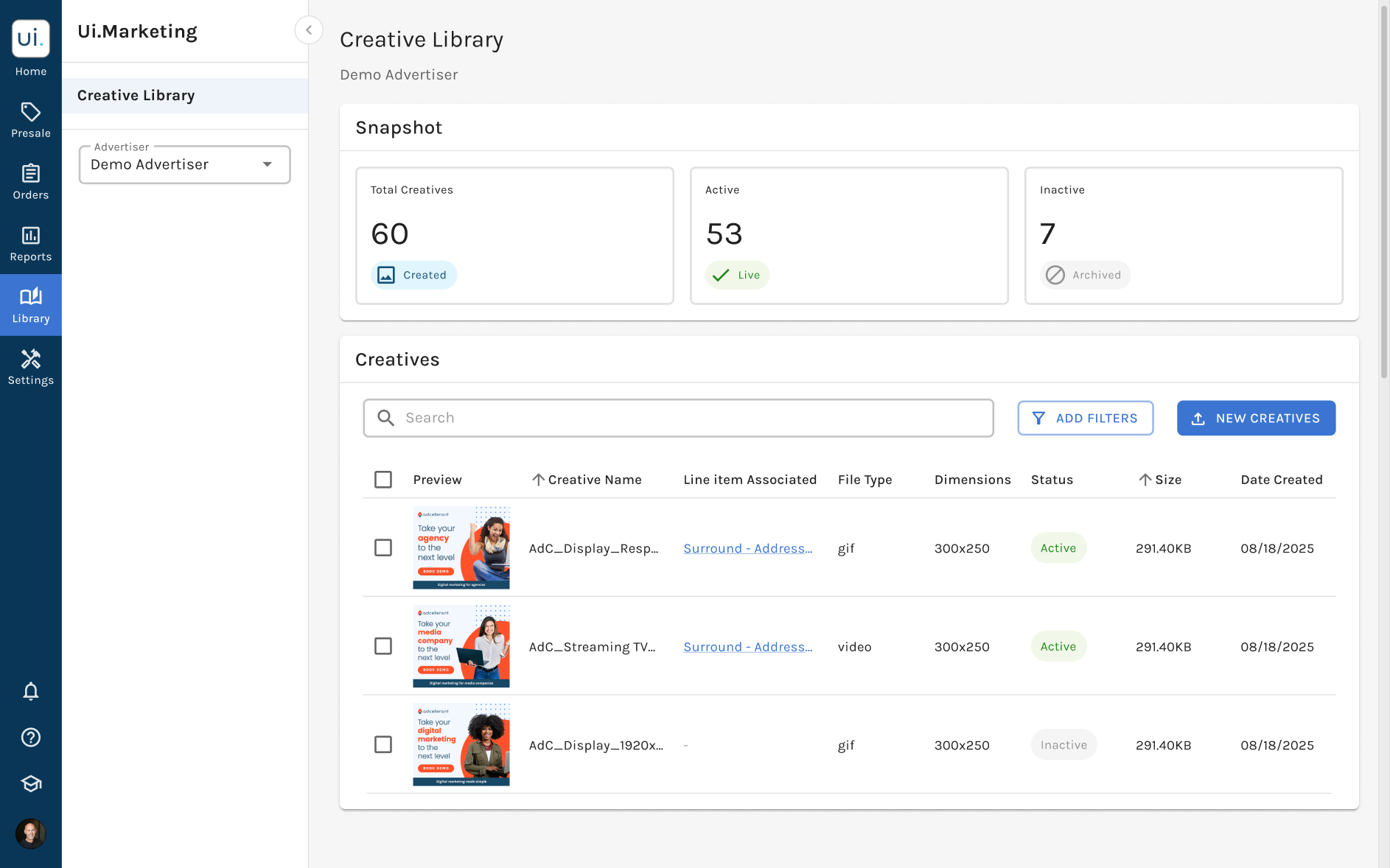
The Creative Library provides a centralized home for uploading, organizing, reviewing, and reusing assets. It is accessible from existing Line Item and Proposal workflows, allowing teams to manage creatives without leaving the task at hand.
Validation
Testing validated a more streamlined approach to creative management.
Unmoderated testing with 42 participants across 5 tasks showed that they successfully completed key workflows for finding, managing, and reusing creative assets, while identifying areas for improvement before development. Because the feature had not launched, business impact was not yet available.
98.4%
Average task completion rate
5.85 / 7
Average SEQ score
Discovery & Strategy
Understanding where creative management broke down across campaign workflows.
The PM identified a Creative Library as a potential solution. I investigated the underlying workflow, identified where teams lost time, and worked with the PM to define the MVP.
📋 User Feedback
30+ feedback items
👥 Operations Interviews
5 interviews
🎯 PM Alignment
MVP scope & success criteria
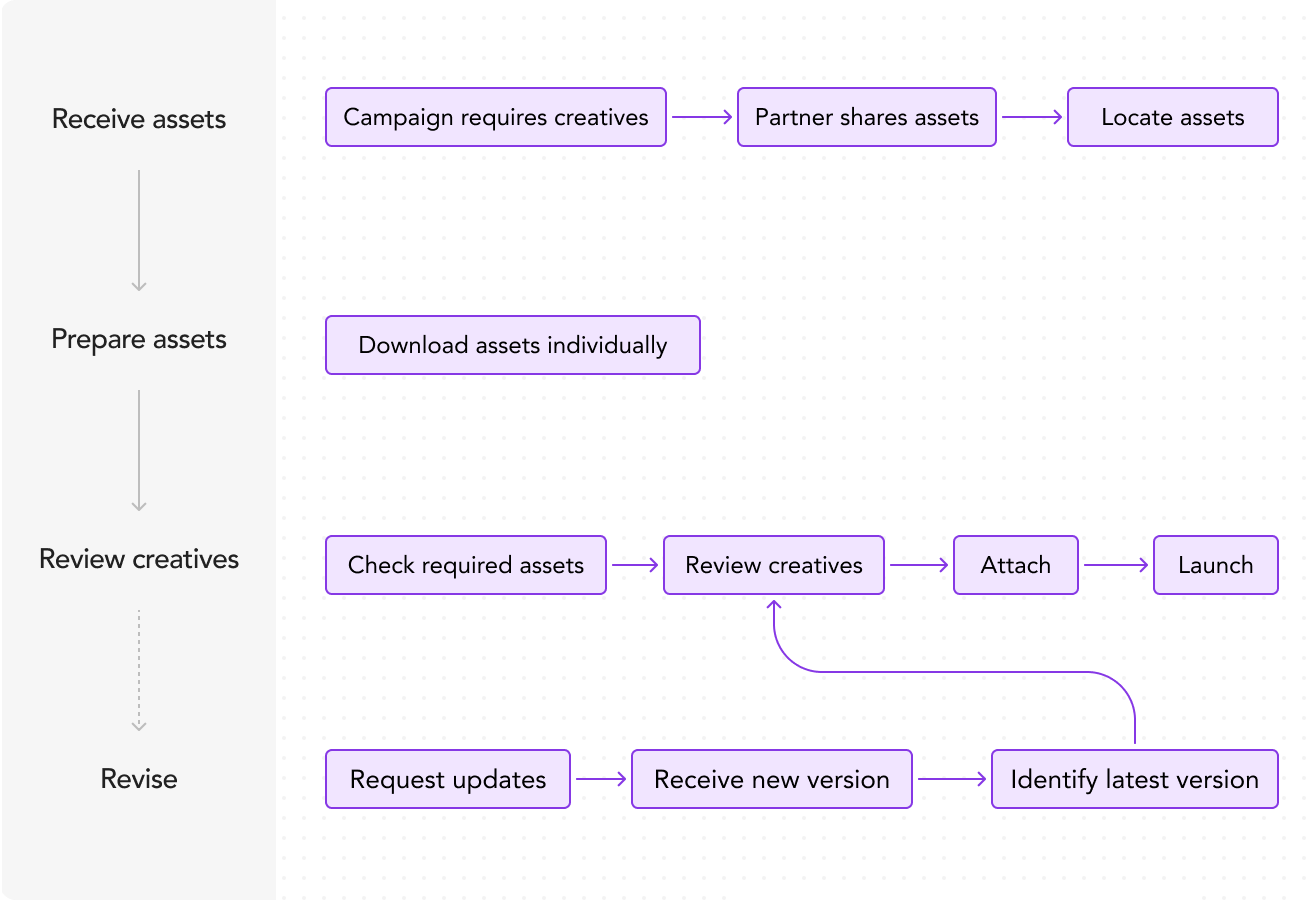
Operations and partners were both primary users, but they were not equally reachable. I interviewed Operations directly, while partner input came through support tickets filed on their behalf. Operations described repeatedly downloading assets from email, uploading them into campaigns, and checking old message threads to confirm which version was approved.
Key findings from the current creative workflow
Synthesizing user feedback and Operations interviews revealed four recurring breakdowns across the creative workflow.
Pain point 1
🗂️ Scattered asset storage
Assets lived across multiple locations, making them difficult to find and reuse.
Pain point 2
📁 Manual file management
Teams repeatedly downloaded, uploaded, and reviewed files individually.
Pain point 3
⚠️ Incomplete submissions
Missing assets required extra follow-up and delayed campaign launches.
Pain point 4
📜 Difficulty identifying the approved asset
Teams struggled to identify the latest approved creative.
Defining the MVP Scope
Not every request belonged in the MVP. Together with the PM, we prioritized capabilities based on workflow impact, business value, scalability, and feasibility. Using these principles, we defined the MVP capabilities:
| Research Finding | Design Insight | Decision |
|---|---|---|
| Scattered asset storage | Create a single source of truth. | Centralized Creative Library |
| Manual file management | Reduce repetitive asset handling. | Bulk actions & preview |
| Difficulty identifying the approved asset | Make each asset's state and owner visible at a glance. | Status, timestamps & ownership |
| Incomplete submissions | Address in the submission workflow. | Separate initiative |
| AI-powered creative generation | Prioritize core management needs first. | Deferred for future release |
Define
Centralize the assets, not the workflow.
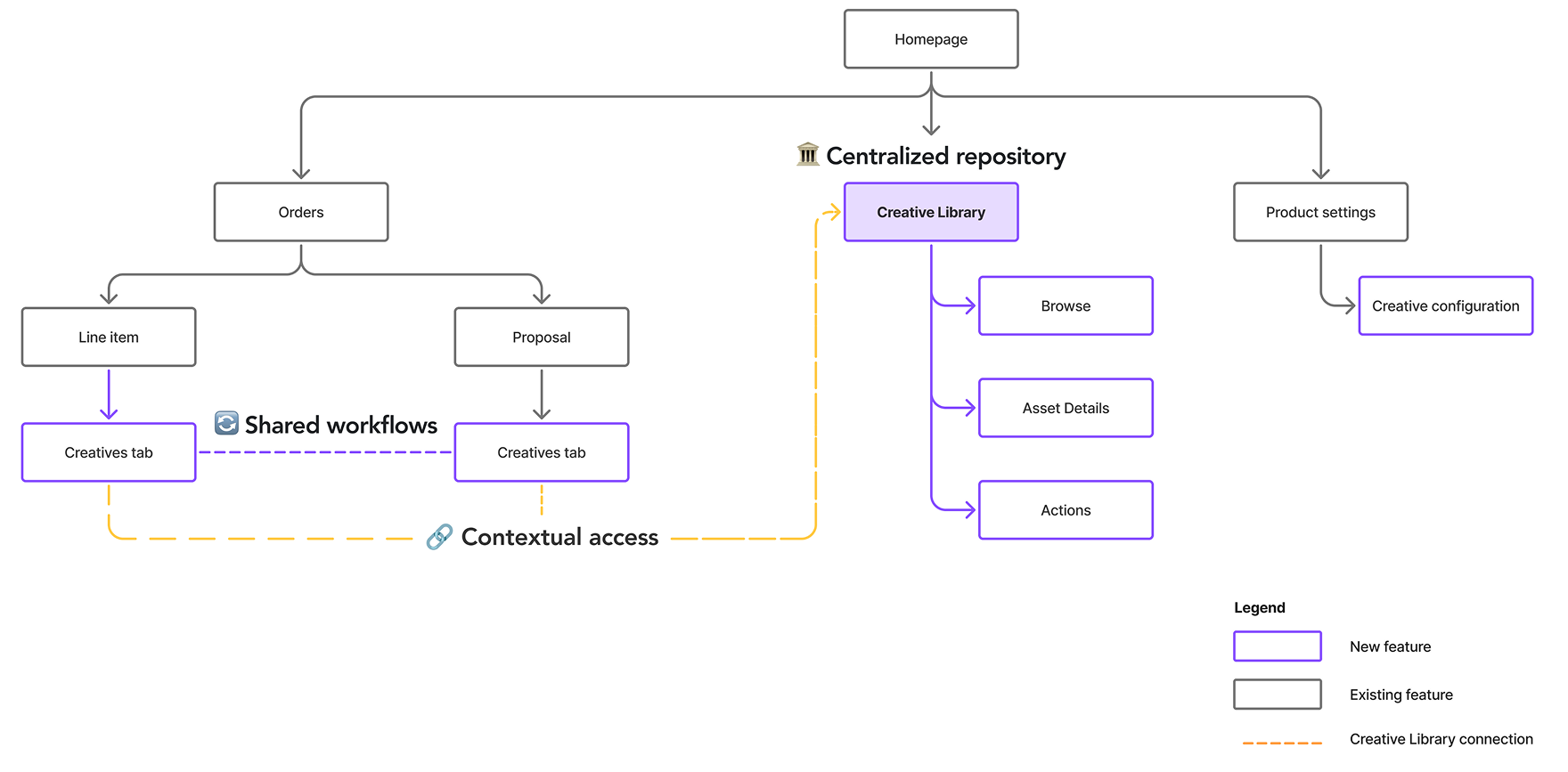
With the MVP defined, I mapped how the repository would connect to existing Line Item and Proposal workflows, then reviewed the model with Product and Engineering to ensure it fit the platform architecture. The final structure connected the standalone library, Line Items, and Proposals to a shared repository.
Key IA decisions
🏛️ Centralized repository
Organize advertiser assets in one place.
🔗 Contextual access
Access creatives from Line Items and Proposals.
🔄 Shared workflows
Reuse consistent patterns across entry points.
Exploration
01 — Making assets easier to find and reuse
Problem Assets were scattered across campaigns, messages, and shared folders, making them difficult to find and reuse.
My approach I explored how assets should be organized and displayed, balancing discoverability with access to key metadata.
Exploration 01 — How should creatives be organized?
Because creatives are tied to specific advertisers, I explored three ways to organize the library. Operations interviewees typically worked within one advertiser at a time, so cross-advertiser browsing was not a common workflow. Based on this insight, I chose advertiser-first navigation to create a focused structure that could scale as the library grew.
Option 1 — Group by advertiser
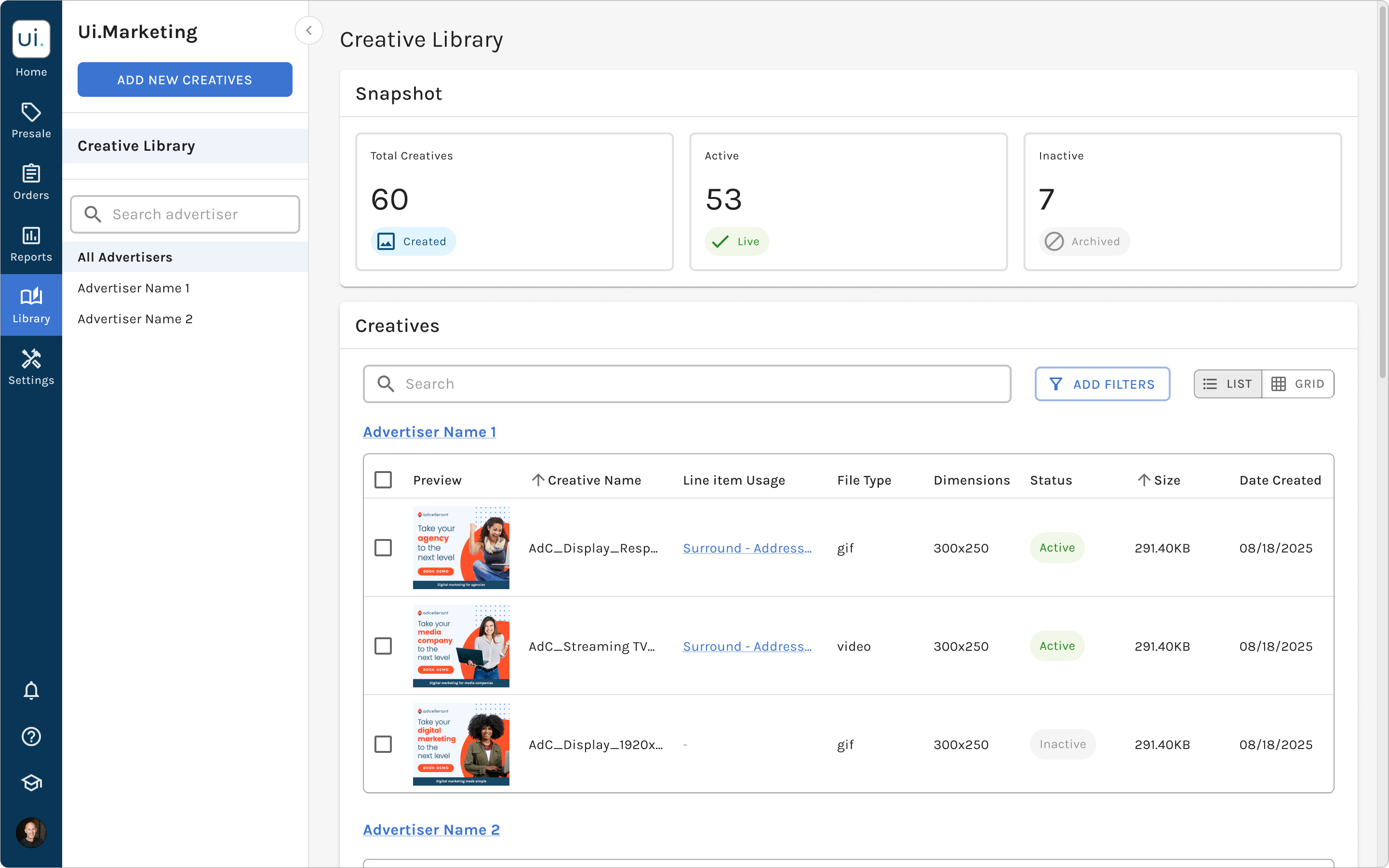
Benefit Creates clearer organization while keeping advertisers visible on one page.
Tradeoff Can create a long, dense library as more advertisers are added.
Option 2 — Filter by advertiser
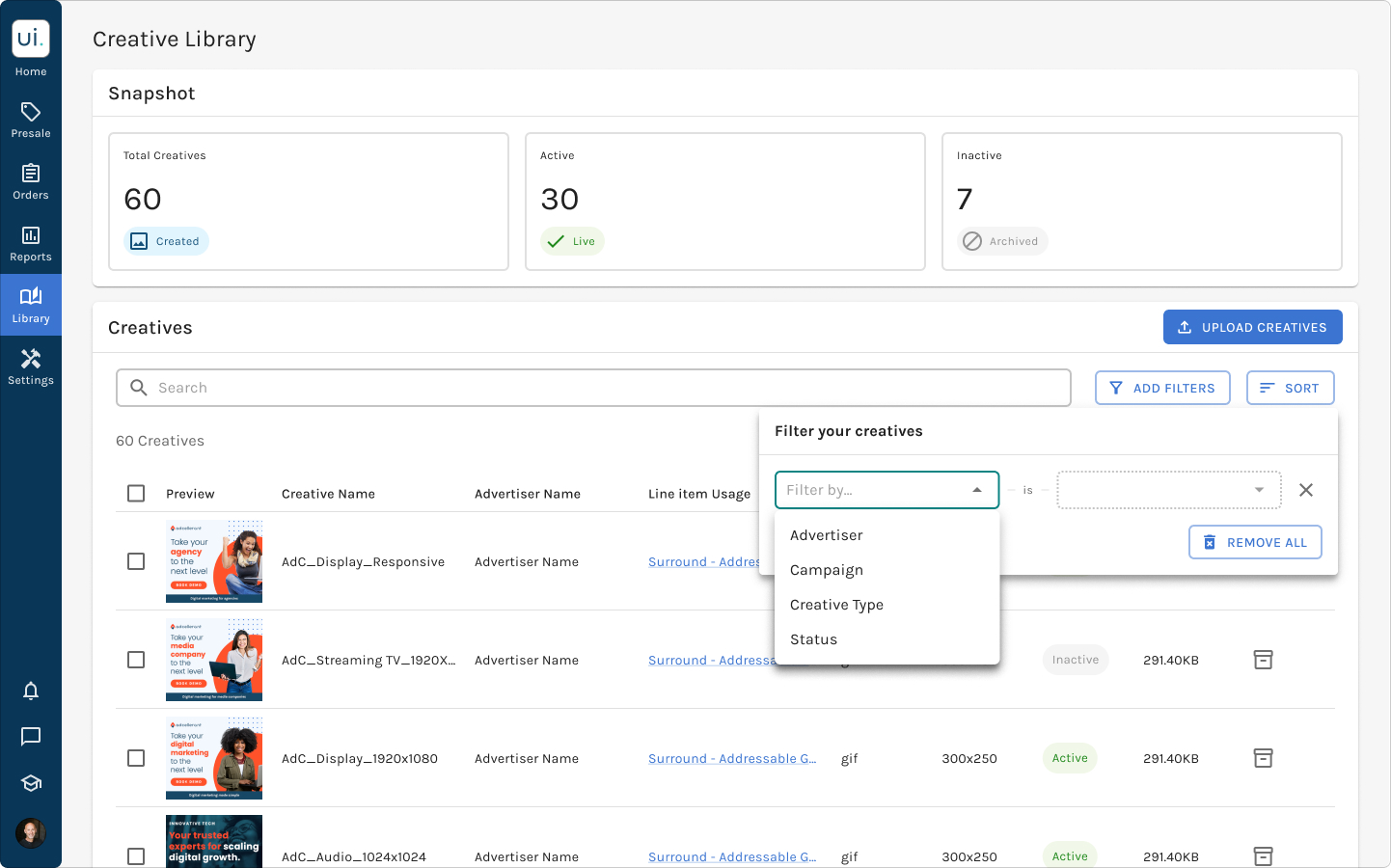
Benefit Keeps all creatives visible in one library and allows quick filtering.
Tradeoff Becomes harder to navigate as the number of advertisers and assets grows.
Option 3 — Navigate by advertiser ✅
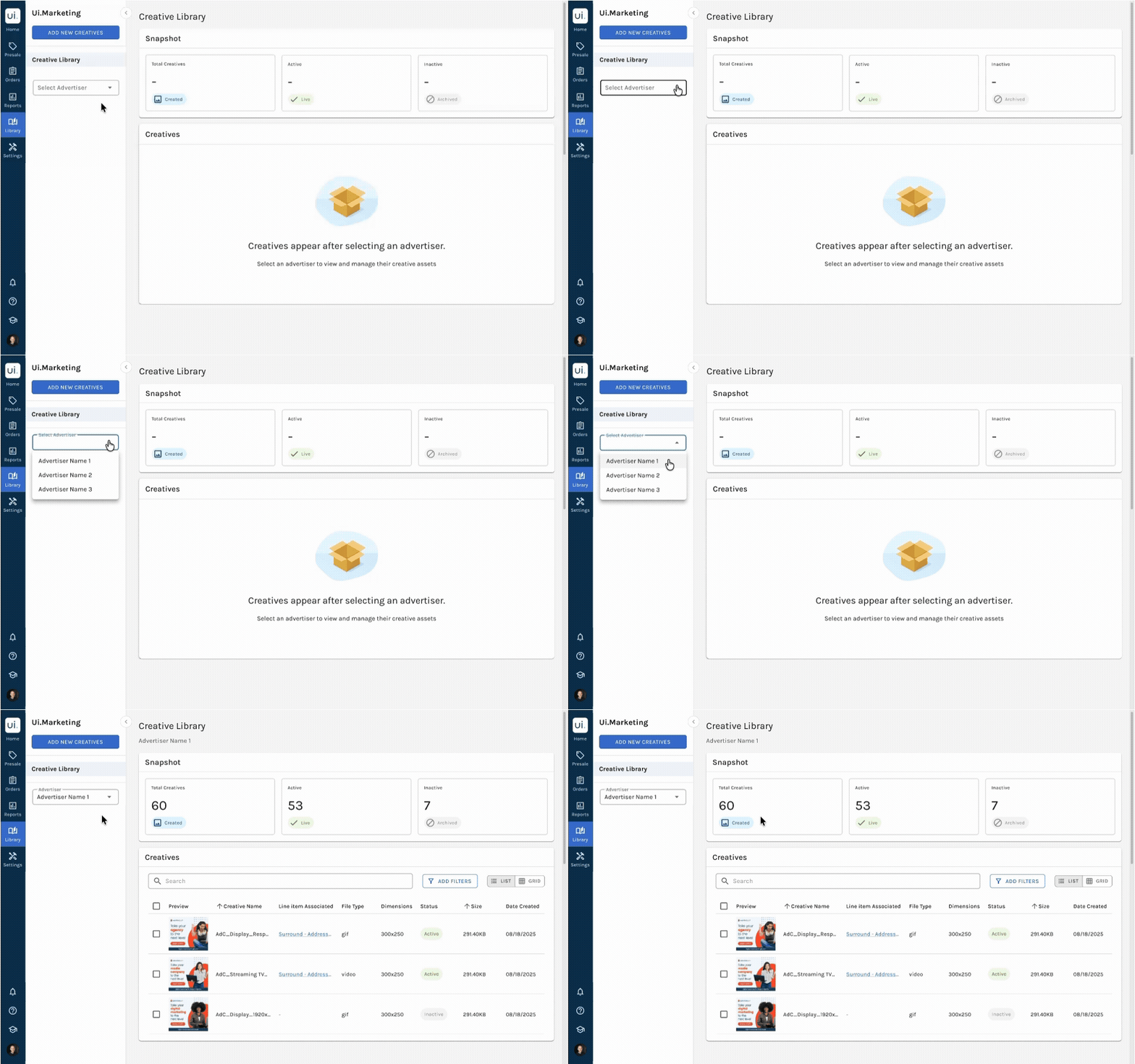
Benefit Creates a focused workspace for each advertiser and scales as the library grows.
Tradeoff Adds one step before users can view creatives.
Exploration 02 — How should creatives be displayed?
Users identify creatives by name, size, status, and where they're running — not by thumbnail. I explored grid and list views and chose the list view because it surfaces more of these attributes at once, while a preview column preserves visual recognition. We deferred an optional grid view because the list supported the primary management tasks and the MVP timeline did not justify building both.
Option 1 — Grid view
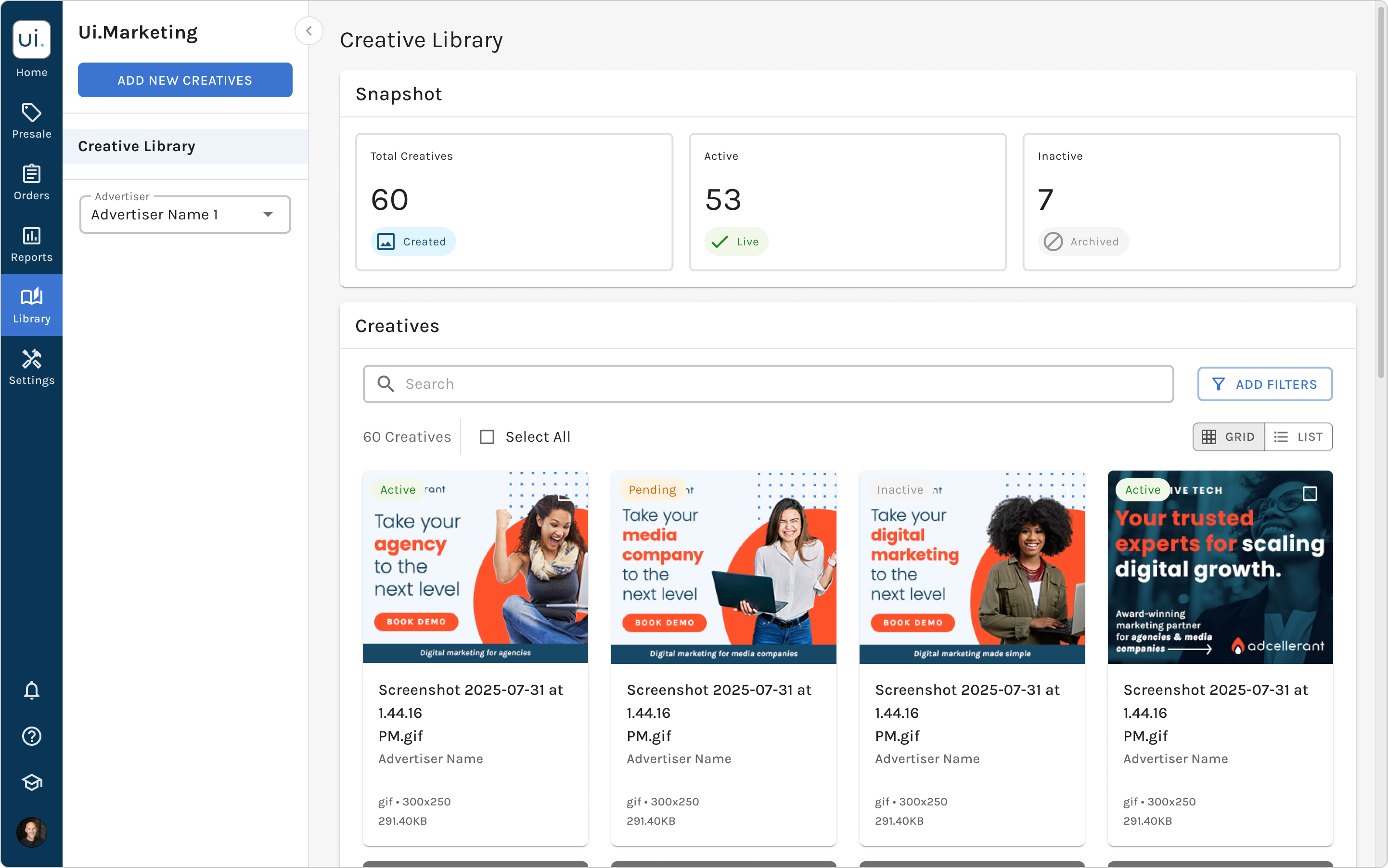
Benefit Easier visual scanning.
Tradeoff Less space for metadata and actions.
Option 2 — List view ✅
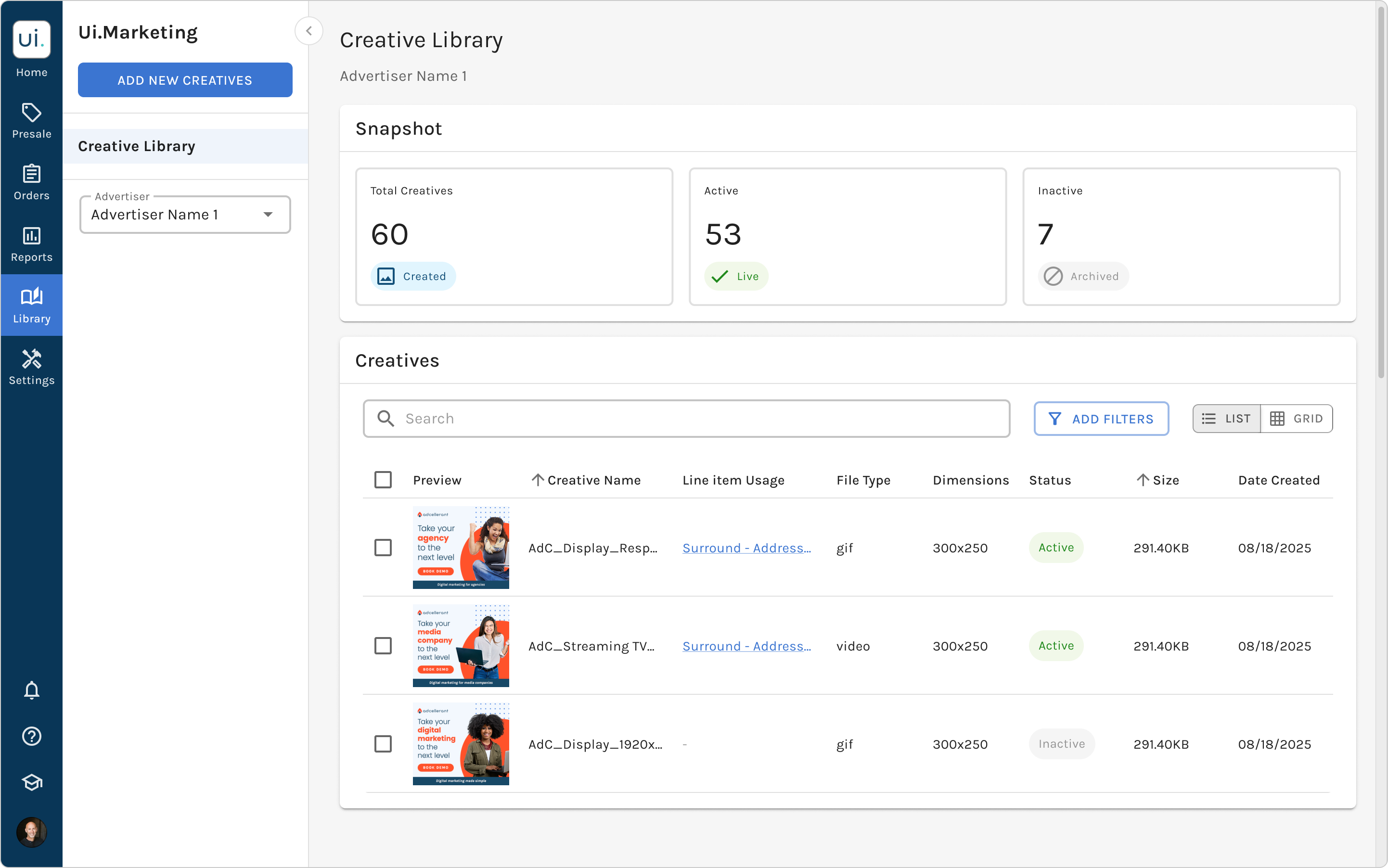
Benefit More metadata for comparison and management.
Tradeoff Smaller visual previews.
Providing context for confident reuse
Finding an asset was only the first step. Before reusing it, users needed to confirm that it was the correct version, understand where it was already running, and verify its status. I designed the details panel around these decisions.
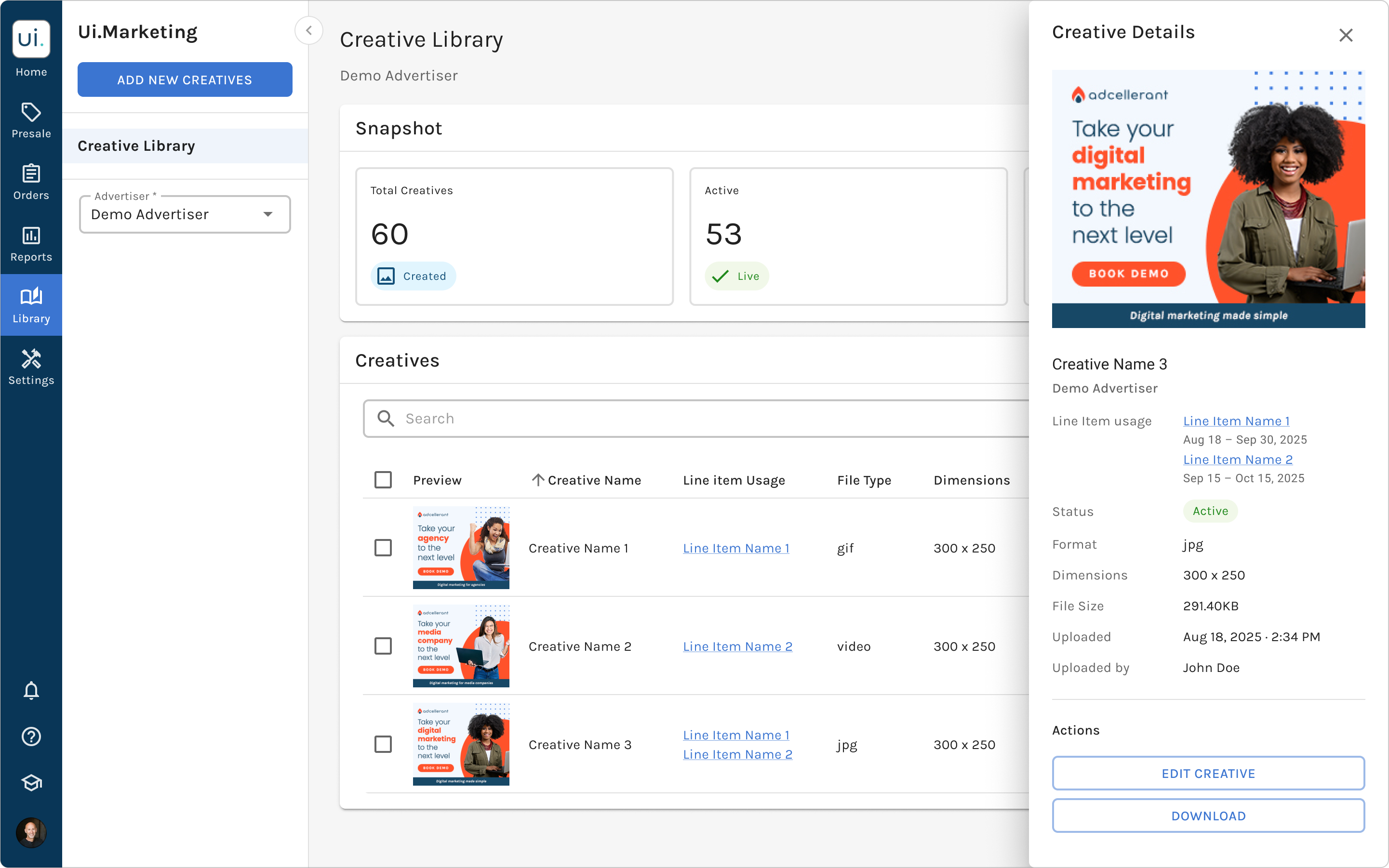
Confirm the creative
Preview the asset without downloading it.
Understand current usage
Review associated Line Items and run dates to see where and when the asset is being used.
Verify the asset details
Check its status, format, dimensions, upload date, and owner before reuse.
02 — Reducing repetitive creative management
Problem Operations managed creatives in sets but had to download, upload, review, and remove files individually. Repeating these steps across campaign setups created unnecessary manual work.
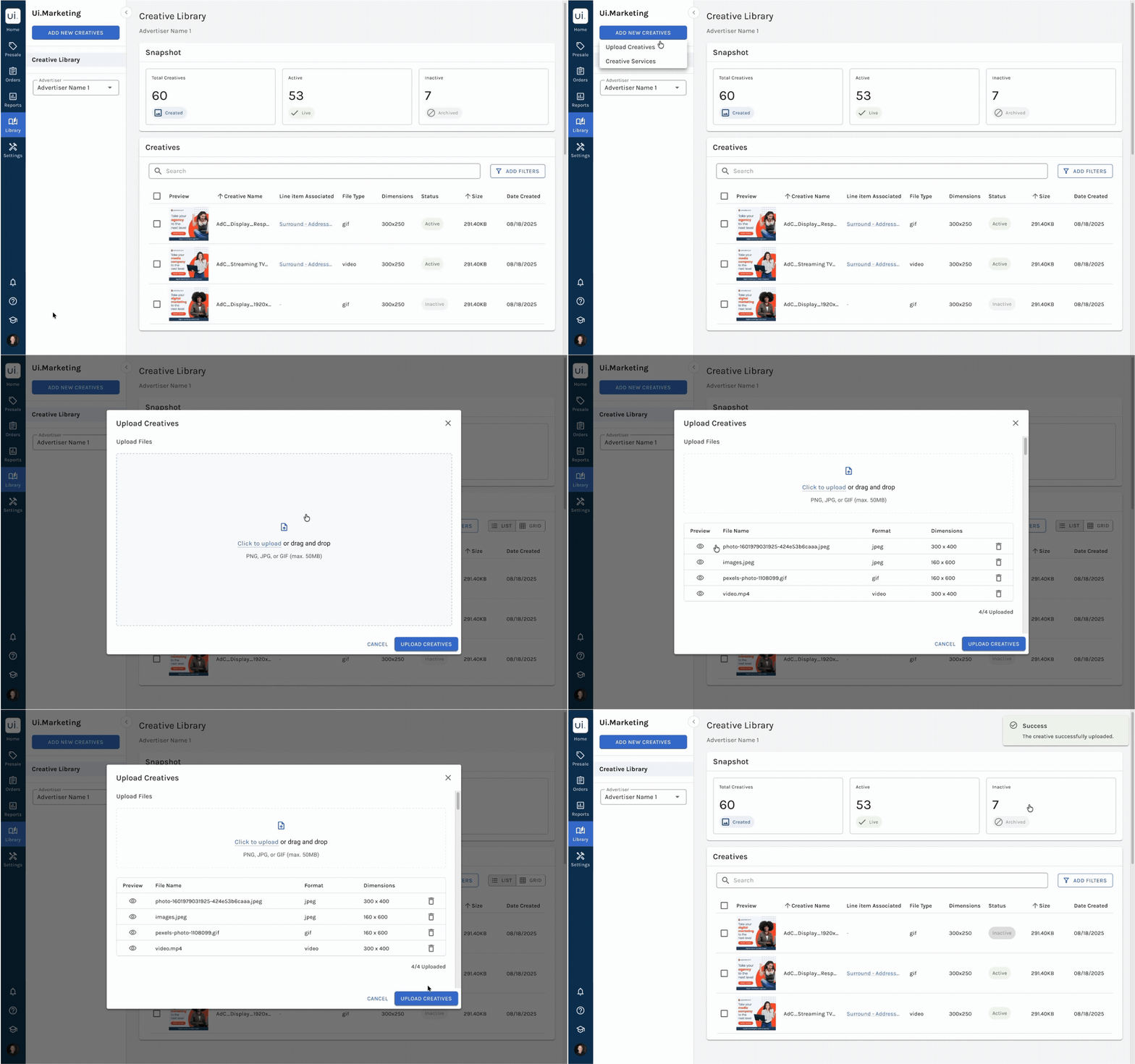
My approach I introduced multi-file upload, multi-select, and contextual bulk actions so users could complete common asset-management tasks across an entire set instead of one file at a time.
Upload and review assets as a set
Users can upload multiple files and review their details in one flow before adding them to the library.
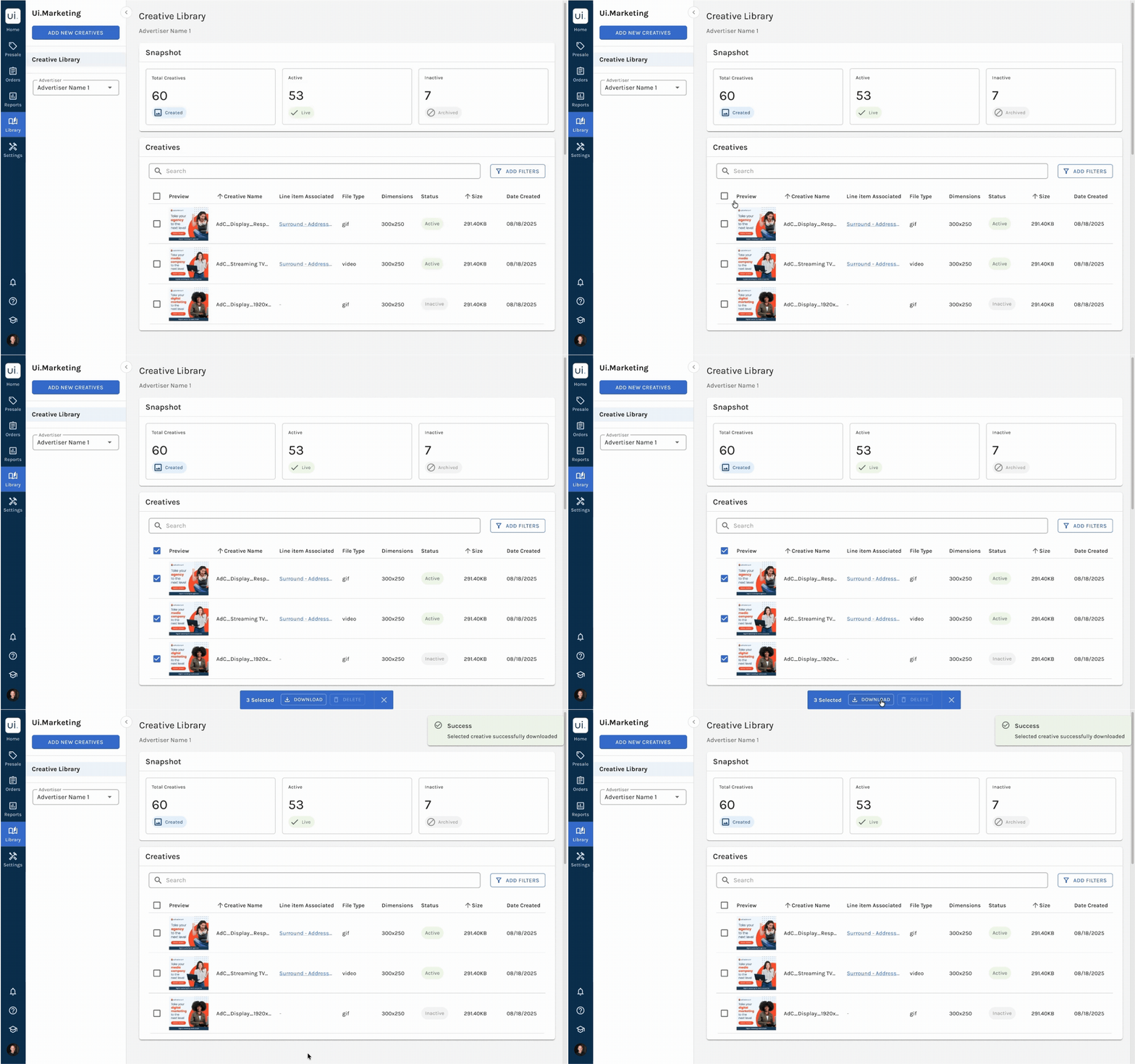
Apply actions across multiple assets
After users select assets, relevant bulk actions appear for tasks such as downloading or removing files. Keeping these controls hidden until selection preserves a focused default view while supporting higher-volume management.
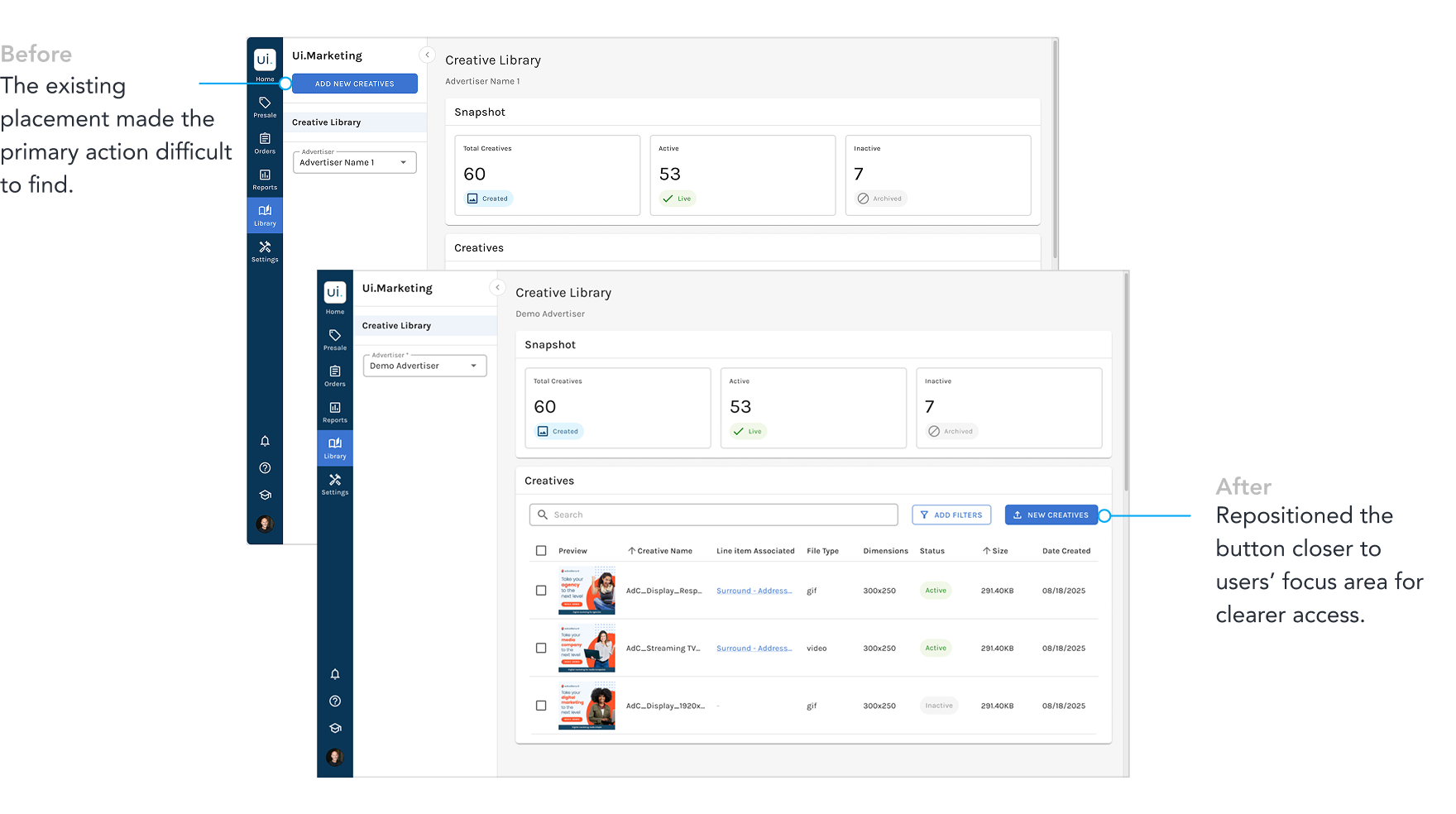
Usability iteration — Making the primary action easier to find
What we learned
Although the “Add New Creatives” button followed existing page conventions, it was difficult to discover. On the upload task, 84% of internal participants and 23% of external participants clicked the creative table before finding the action. Although most participants eventually completed the task, their click behavior revealed significant friction.
Iteration
I moved the primary action above the creative table, closer to the area where participants expected to begin the task. This prioritized discoverability over strict consistency with existing page patterns. I revised the placement for handoff; the updated design still requires validation.
03 — Integrating creatives into existing workflows
Problem Users needed to manage creatives while building Line Items and Proposals. Sending them to a separate library would interrupt their existing workflow.
My approach I embedded creative management into Line Items and Proposals, allowing users to upload or reuse assets in context.
Design decision — Bring the library into the workflow
Avoided
Designed
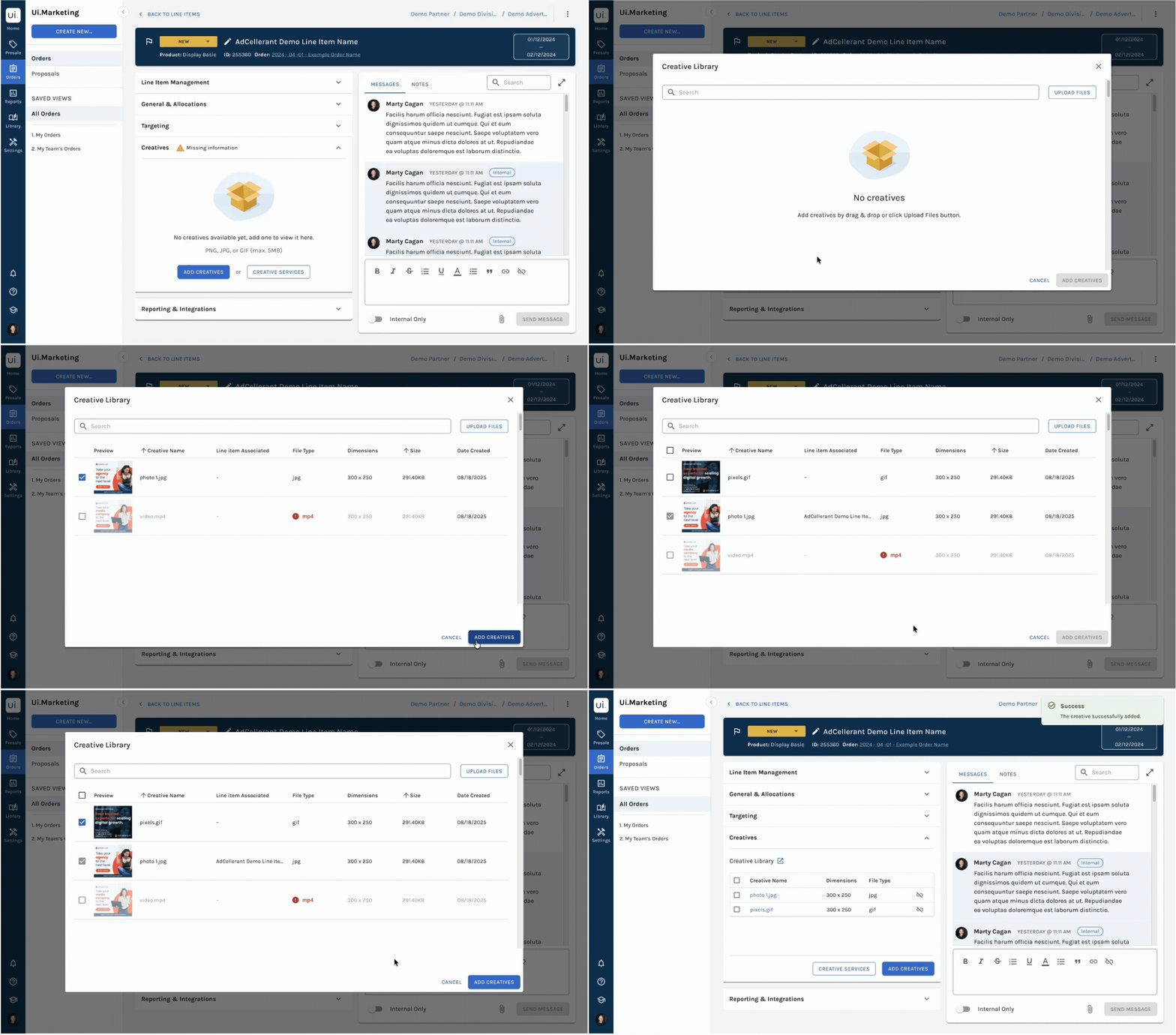
🔗 Stay in context
Reuse existing assets without leaving the Line Item.
🔄 Shared pattern
The same interaction extends to Proposals.
System consideration: Removing a creative from a campaign does not delete it from the shared library, preventing changes in one workflow from unintentionally affecting future reuse.
Final Design
One shared library supporting the end-to-end creative workflow.
The final design brings asset discovery, management, and reuse into one connected system.
Find and evaluate assets
Search creatives and review key details before reuse.
Manage assets efficiently
Upload, review, and manage multiple creatives at once.
Reuse assets in existing workflows
Upload or select creatives from Line Items and Proposals.
Reflection
Not every pain point belongs in the same solution.
Research surfaced issues beyond asset management, including incomplete creative submissions. Rather than expanding the Creative Library to solve everything, we recognized that some problems were better addressed within the broader workflow. This helped keep the MVP focused while preserving opportunities for future improvements.
Consistency should support usability, not constrain it.
I initially followed existing platform patterns for actions such as adding creatives. Usability testing showed that consistency alone wasn't enough when the primary action was difficult to discover. Repositioning it reinforced the importance of using established patterns as a starting point—not as a rule when user behavior suggests otherwise.
Next Steps
Measure adoption and refine the experience after launch.
After launch, I would track library adoption, the percentage of campaigns reusing existing assets, and the time from asset receipt to campaign readiness. These measures would show whether the library reduced repeated requests — not merely whether users opened it — and whether removing this friction contributed to the hypothesized 10% increase in creative service orders.